Roadmap Europa

European marketing, media and design mixed with some personal anecdotes and travels.

Monday, March 31, 2008

'Neurobiotesting'


Market research has traditionally been heavily reliant upon the academic fields of statistics, sociology and psychology but in recent years, technologies more related to medicine and biology have been attracting attention.

Around the turn of the millennium we looked into eye tracking technologies for testing people's interaction with websites. We reached the conclusion that this type of testing was great for testing very specific aspects of a website but harder to use to explain the overall experience or the user's reactions and behaviour on the site.

Soon after I received an offer to test using MRI scans to measure brain activity in response to advertising and websites - unfortunately I didn't have the time to look into it further. More recently, this type of research has been attracting quite a bit of attention. Even Spanish gossip TV programs have lie detectors ready to probe the almost-famous and wannabes in their hunt for the most salacious insight possible.

The New York Times recently covered how start-up research companies such as Neurofocus and Emsense are using MRI scans to help work out which ads create a better response and engage viewers. Earlier this week the International Herald Tribune reported how Disney are building biometric research facilities in Austin to test different technologies and advertising formats.

In the Times article, the head of Virgin Mobile's research in the US said he wasn't a fan of ad testing but found this type of research useful. If I was ever asked I think I'd respond, "I'm not a huge fan of ad testing but it is useful. Biometric and 'neuro' research make an interesting addition when I have plenty of budget, want to indulge my sadistic impulses and can convince enough participants to irradiate themselves."

Emsense used their 'neuro' testing to demonstrate that award winning ads really do engage consumers more than the average garden ad. So now we know ad awards are rewarding more than creatives' self-love.

What would be most interesting is a comparative study to see how well focus groups, depth interviews and surveys can identift these responses, compared with 'neuro' testing. Are groups or depths better at identifying emotional responses? Can surveys alone do the job?

It is always fun playing around with the latest technology, unless you are the poor participant rigged up like a lab rat. Is that pupil dilation due to: A) the wires the participant has stuck to them; B) the laser being shot into their eyes; C) the MRI scanner shooting radiation through them; or D) an emotional response to the ad in front of them?

Unfortunately, none of these technologies, not even MRI scans, can tell us what people are thinking or their subconscious reactions. 'Neuro' and 'bio' testing give us some wonderful clues as to the class of reaction being generated, helping explain how and when we react to different stimuli but these tests tell us little about exactly what that reaction is and why is it being generated.

To understand why we react to an ad in a particular fashion still forces us to fall back on asking someone to explain themselves in a group or do some task to help us infer their motivations. An imprecise science and a difficult art...

Labels:

Monday, April 23, 2007

Getting to grips with new media

While new media has been moving ahead at a rapid rate for several years, many of the bigger ad agencies seem to have had trouble catching up, with the pace being set most often by smaller digital agencies.

A survey by Forrester in the US earlier this year found that agencies overestimated their impact with clients. There were several areas of difference between clients and agencies the most glaring of which was that while 95% of agencies believed they were well equipped to deal with new media, only 45% per cent of clients agreed. The report found that digital agencies had been on the resurgence since the dotcom boom went bust.

Anecdotally it always seemed a tough sell to get traditional agencies to really devote themselves to new media with all the extra effort it required of them compared to managing a traditional TV or print campaign. At the same time the media spend for an online campaign was less and so there was less financial incentive. So while the client might carry a stick there wasn't much carrot. Watching clumsy TV commercials being rerun as online video ads, it seems some agencies continue to struggle to have the commitment or skills to put together a rounded integrated campaign.

I came across an interesting article in the Financial Times where the leaders of the UK ad industry shared their thoughts on the changes wrought by new media, some of which I've paraphrased below. They range from the defensive to progressive and considering it is now more a decade since the Internet first made an impact you wonder how much time some people need, especially an industry that is meant to be ahead of the curve...

STEVE HENRY, Executive creative director, TBWA\London
"People want to be entertained; they don't want to be sold to using the old advertising model. It's about competing for people's time...this is the fundamental change that's going on. What is creativity in advertising? I now think of it as anything that affects that brand. There shouldn't be any media attached to it."


TONY DAVIDSON, Executive creative director, Wieden + Kennedy London
"Do I think there's a crisis? No - but there are too many agencies focusing on their clients' comfort zones rather than on the brand's success. The result of that is, at best, instantly forgettable creativity. The creative side of the industry is not in crisis - it's just not as good as it could be."

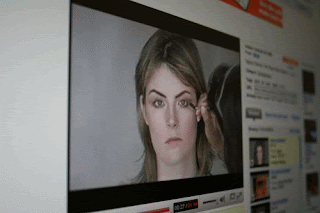
Dove's Evolution campaign produced results, adshow awards and some good consumer generated parodies: http://www.youtube.com/watch?v=LEtP3U8a4v0&mode=related&search=

JOHN HEGARTY, Chairman and worldwide creative director, BBH
"Would I say "crisis"? I think there's a confusion... an enormous number of new media have opened up and as yet we are not absolutely sure how to use them...online media is so new that it's very difficult to understand absolutely how people are relating to it. We have had to move from a "learn and do" culture to a "do and learn" culture... some people find it quite unnerving and are not sure how to move forward...there is confusion now. Some will claim they have an intimate understanding of it all because everybody in advertising always claims an intimate understanding of everything."


TREVOR BEATTIE, Chairman and creative director, BMB
"No, there is no creative crisis...blogging, by rank amateurs, is having an impact on journalism but there isn't a blogging equivalent of adverts; people merely mash-up the existing work. There aren't going to be people sitting around having ideas for chosen brands, whereas there are people blogging about any random thing. If there is a situation in advertising, it's time. Your first idea has to be the right one and there's no time to craft it. Everything is about speed and the great boast is to be able to deliver faster. So some of the ideas are less considered and I think that's a problem."

TIM DELANEY, Chairman, Leagas Delaney
"The big companies are about heavy-duty results. They have got to have quarterlies. Big agencies set the tone, and if they set a financial tone, they change the nature of the business. And the digital revolution has thrown a new group of people into the creative arena, who are not necessarily ideas-driven but are geeky or digitally driven."

Labels: